Running production from 3,524 metres: what altitude teaches you about latency
When your office is in Leh, Ladakh, and your clusters are in Frankfurt and Singapore, every architectural decision is a latency decision. What I learned about infrastructure from operating at altitude.
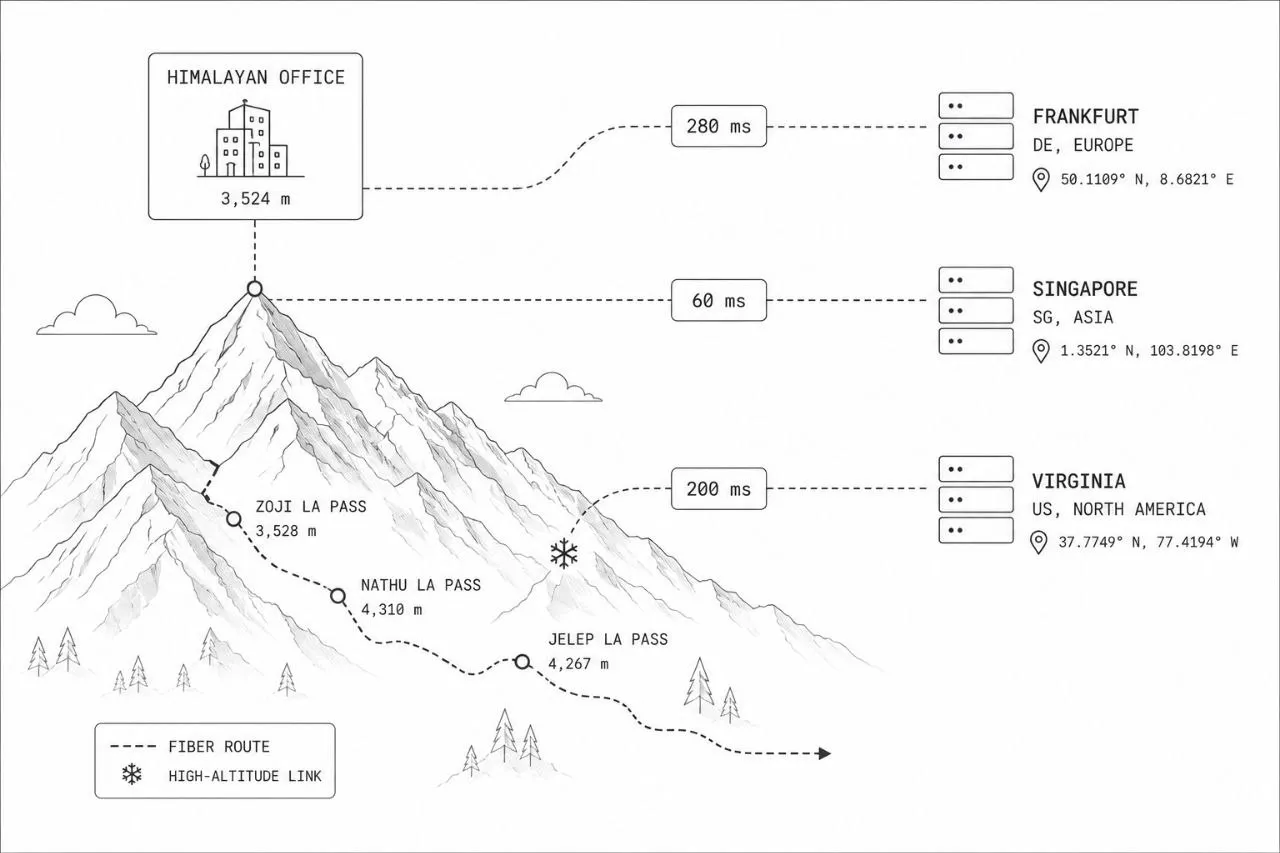
I work from Leh, Ladakh. 3,524 metres above sea level. The air is thin, the winters drop to minus twenty, and the fiber to my office passes through mountain passes that freeze. When the snow melts in spring, the road to Srinagar opens and the telecom crews fix whatever the winter broke.
My clusters run in Frankfurt, Singapore, and occasionally Virginia. My clients are in the EU, the Middle East, and increasingly the US. The distance between my keyboard and the control plane is not a metaphor. It is a latency budget I think about every single day.
The first lesson: you cannot debug what you cannot observe
When your round-trip time to the API server is 280 milliseconds, kubectl is not a tool, it is a meditation practice. kubectl get pods takes a full second. kubectl logs -f stutters. kubectl exec into a pod is an exercise in patience that would try a monk.
The first thing I built when I moved here was not a faster connection. It was observability. Prometheus scraping with a remote write to a local Thanos receiver. Grafana dashboards that I could reach in 30ms instead of 3 seconds. Alertmanager rules that told me what was wrong before I had to ask.
If you cannot see the system, you cannot fix the system. At altitude, this is not a preference. It is a survival strategy.
The second lesson: the CDN is your edge, not your cloud
Most teams treat the CDN as a caching layer for static assets. When your users are 200ms from the origin, that is fine. When your users are distributed across three continents and your origin is a single region, the CDN is your entire user experience.
I learned to design for the edge early. API responses cached at the CDN with short TTLs. Static assets pushed to Cloudflare R2 or Backblaze B2, served from the nearest POP. HTML rendered at the edge with Cloudflare Workers when the origin is too far to wait for.
The question I ask for every endpoint: can this be served from a POP? If yes, it should be. If no, the origin needs to be close enough that the user does not notice.
The third lesson: the cloud is not where you live
There is a datacenter in Delhi. There is a datacenter in Mumbai. For most of India and the Middle East, that is the closest cloud region. For me, it is still 60ms away, through a fiber route that sometimes goes down because a truck hit a pole on the Leh-Manali highway.
The myth of the cloud is that it is everywhere. It is not. It is in specific buildings in specific cities, and the distance between you and that building is the distance between you and your production system. If that distance is large, every design decision must account for it.
I run a local mirror of critical infrastructure. A local Docker registry cache. A local NTP server. A local DNS resolver. When the fiber goes down, and it does, I can still see my local systems. I cannot reach the cluster, but I can see the monitoring that tells me the cluster is unreachable, which is different from the cluster being down.
The fourth lesson: automation is not optional at distance
When you are five and a half hours ahead of the Eastern US and three and a half hours behind Singapore, there is no business hour that works for everyone. The only way to operate is asynchronously. The only way to operate asynchronously is to automate everything that does not require human judgment.
CI/CD is not a nice-to-have. It is the only way changes ship without me being awake at the right time. ArgoCD syncs happen when they happen. Rollbacks trigger automatically when the health check fails. Alerts route to PagerDuty, which routes to my phone, which wakes me up if it matters.
I do not deploy manually. I have not deployed manually in two years. Not because I am ideologically opposed to it, but because the time zones make it impossible to be present for every deployment window.
The fifth lesson: the mountain does not care about your uptime
Leh loses power. Not often, but enough. The backup generator kicks in after four minutes. The UPS holds for ten. If the generator fails, which it has twice in three years, everything goes dark including the Starlink that is my backup internet.
I have a laptop with a local k3s cluster for testing. I have the cluster state replicated to a local NAS. I have a battery bank that can run the router and the laptop for six hours. None of this is paranoia. It is the cost of operating from a place where the infrastructure was not designed for always-on digital work.
The lesson is simple: your system is only as reliable as the weakest link between you and it. For most engineers, the weakest link is the cloud provider. For me, it is sometimes the electricity. I plan for both.
What altitude actually teaches you
Living at 3,524m does not make you a better engineer. The mountain does not care about your SLOs. But it does force a discipline that is easy to skip when you are in a city with a datacenter down the road:
You observe before you act. You automate what you can. You cache at the edge. You plan for the fiber going down. You accept that you are far from the system and design accordingly.
These are not mountain lessons. They are engineering lessons. The mountain just makes them non-negotiable.