Himalayan peak emerging from mist
Kubernetes Prometheus Argo Helm OTel Envoy Cilium Agents
kagent K8sGPT kgateway Kyverno KubeArmor MCP vLLM Claude
Tallinn · Estonia · est. Apr 2026

Aultis

DevOps engineered with the patience of altitude — practiced with a new generation of agents.
— Philosophy

Infrastructure as a quiet practice.

Aayan Mateen grew up in Leh, Ladakh — at 3,500 metres, where the air is thin and patience is not optional. That is where the doctrine of Digital Aultis comes from. Not a metaphor borrowed from mountaineering literature, but a way of moving through the world that was learned before it was applied to systems.

Every pipeline we lay, every cluster we tune, is a small act of stillness against the noise of modern software. Observe before you act. Move deliberately. Leave no trace.

— Practice
All services →
01 / 07

Cloud Architecture

Multi-region foundations on AWS, GCP and bare metal. Designed once, scaled silently.

02 / 07

CI/CD Pipelines

Deployment as a calm ritual — reproducible, signed, observable, reversible.

03 / 07

Site Reliability

SLOs, error budgets, on-call hygiene. We measure stillness in nines.

04 / 07

Platform Engineering

Internal developer platforms that turn velocity into a steady cadence.

07 / 07

Agentic Pipelines

LLM serving, tool orchestration and agent observability — intelligence that runs quietly and accountably.

— Agentic Practice

DevOps, practiced with agents.

We practice DevOps with a semi-agentic approach. AI agents sit inside our pipelines, our incident response and our review process — observing, diagnosing, and drafting actions for human approval. The human is always in the loop. Agents propose. Humans decide. The system executes.

Every solution below is curated, not improvised: chosen for restraint, wired for auditability, and deployed only where it removes noise rather than adding it.

a/01

Self-Healing Pipelines

Agents that watch CI, diagnose the failure, retry what is transient and roll back what is not — before a human is paged.

a/02

SRE Co-pilot Agents

Incident triage agents that read traces, metrics and runbooks, then draft the first response while the on-call engineer is still pouring tea.

a/03

Agentic Code Review

Policy-aware review agents wired into every pull request — security, style and architectural drift caught at the door, quietly.

a/04

MCP Tool Gateways

Your internal tools exposed to agents through governed MCP servers — scoped, audited, revocable. Capability without exposure.

a/05

Agent Observability & Evals

Traces, evaluations and drift guards for agents in production. If intelligence acts on your systems, it acts on the record.

a/06

Agentic Runbooks

Runbooks that execute themselves under human approval — remediation as a reviewed, reversible, one-click ritual.

a/07

Agentic Platform Engineering

The paved road for agents themselves — an internal platform where teams declare, deploy and observe agents the way they ship services. Golden-path templates, scoped credentials issued and revoked centrally, evals wired into CI, one quiet route from prototype to production. Your platform team built roads for services; we extend them to colleagues made of configuration.

— Elevation Gains

What quiet infrastructure earns you.

The DORA research is clear: teams that automate deliberately deploy more, recover faster, and break less. These are not promises. They are the measurable consequence of doing the boring work well.

Deployment frequency
46x
higher with GitOps (DORA)
Incident recovery
96x
faster with progressive delivery (DORA)
Provisioning time
50%
faster with Infrastructure as Code
Vulnerabilities
50%
fewer with policy-as-code (GitHub/IBM)
Target uptime
99.999%
Deployment variance
Zero
Target recovery
< 4 min
Founded
Apr '26
— Basecamp

€60-100k for a hire.
6 months to find one.
7 weeks for working infra.

You just raised. Every day without CI/CD is a day you are one bad deploy from an outage. Every day without observability is a day you are flying blind.

Basecamp builds your foundation in 7 weeks. CI/CD with GitOps. Cloud architecture on the right provider. Observability from day one. Security baseline. Runbooks your team can follow at 4am.

You own everything. When you hire, you hire for the right seat.

Week 1
01

Terrain Reading

Audit. Assess. Map the terrain.

Architecture auditCost analysisSecurity baseline
Weeks 2-3
02

Base Camp

Build the foundation.

GitOps CI/CDObservabilitySecurity policies
Weeks 4-6
03

First Ascent

Ship through the new system.

First deployProgressive deliveryAlerting tuned
Week 7
04

Handover

Keys, docs, hiring profile.

DocumentationRunbooksHiring profile
CI/CD
Observability
Cloud Architecture
Security
Runbooks
Everything as Code
Explore basecamp 7 weeks. €1,990 one-time. Your infra. Your code. Your repo.
— Cloud Native

Built on the CNCF landscape.

We build on the Cloud Native Computing Foundation ecosystem — graduated projects first: Kubernetes, Prometheus, Argo, Helm, OpenTelemetry, Envoy, Cilium. Vendor-neutral by doctrine, so your platform outlives any single cloud, contract, or fashion.

Kubernetescncf
Prometheuscncf
ArgoCDcncf
Helmcncf
OpenTelemetrycncf
Envoycncf
Ciliumcncf
Backstagecncf
Terraform
GitHub Actions
AWS
GCP
Azure
Cloudflare
Docker
Ansible
Claude
vLLM
— Agentic Toolchain

The cloud native agent stack, curated.

The CNCF landscape is growing an agentic layer. These are the projects we watch, deploy and harden for clients — each marked with where it stands in the foundation.

CNCF sandbox

kagent

Kubernetes-native agent framework for DevOps and platform teams — agents declared as CRDs, tools spoken over MCP, governed inside your GitOps workflow. Cluster inspection, policy generation, automated remediation.

CNCF sandbox

K8sGPT

The automated SRE — scans the cluster, triages what it finds, and explains failures in plain language using local or remote models, with remediation guidance attached.

ecosystem

HolmesGPT

An autonomous investigator for production incidents — reads platform telemetry, walks the evidence, and drafts the root-cause story before the human arrives.

CNCF sandbox

kgateway

Next-generation Kubernetes gateway (formerly Gloo) built for the agentic transition — agent-to-agent communication, traffic shaping and tool routing for autonomous workloads.

envoy ecosystem

Envoy AI Gateway

Envoy extended for intelligence — manages, secures and routes inference and agentic tool-calling traffic, with emerging MCP connectivity for distributed agents.

CNCF incubating

Kyverno

Policy as code, now agent-aware — paired with frameworks like kagent, policies are generated, validated and mutated through natural language instead of hand-written YAML.

CNCF sandbox

KubeArmor

Runtime security for agentic workloads — discovers security posture, enforces zero-trust bounds and intercepts threats at machine speed, without waiting on an operator.

kubernetes-sigs

Agent Sandbox

Isolation primitives for agents that act — gVisor and Kata Containers-backed sandboxes giving autonomous workloads a safe, multi-tenant place to run.

— Anatomy

How it works, end to end.

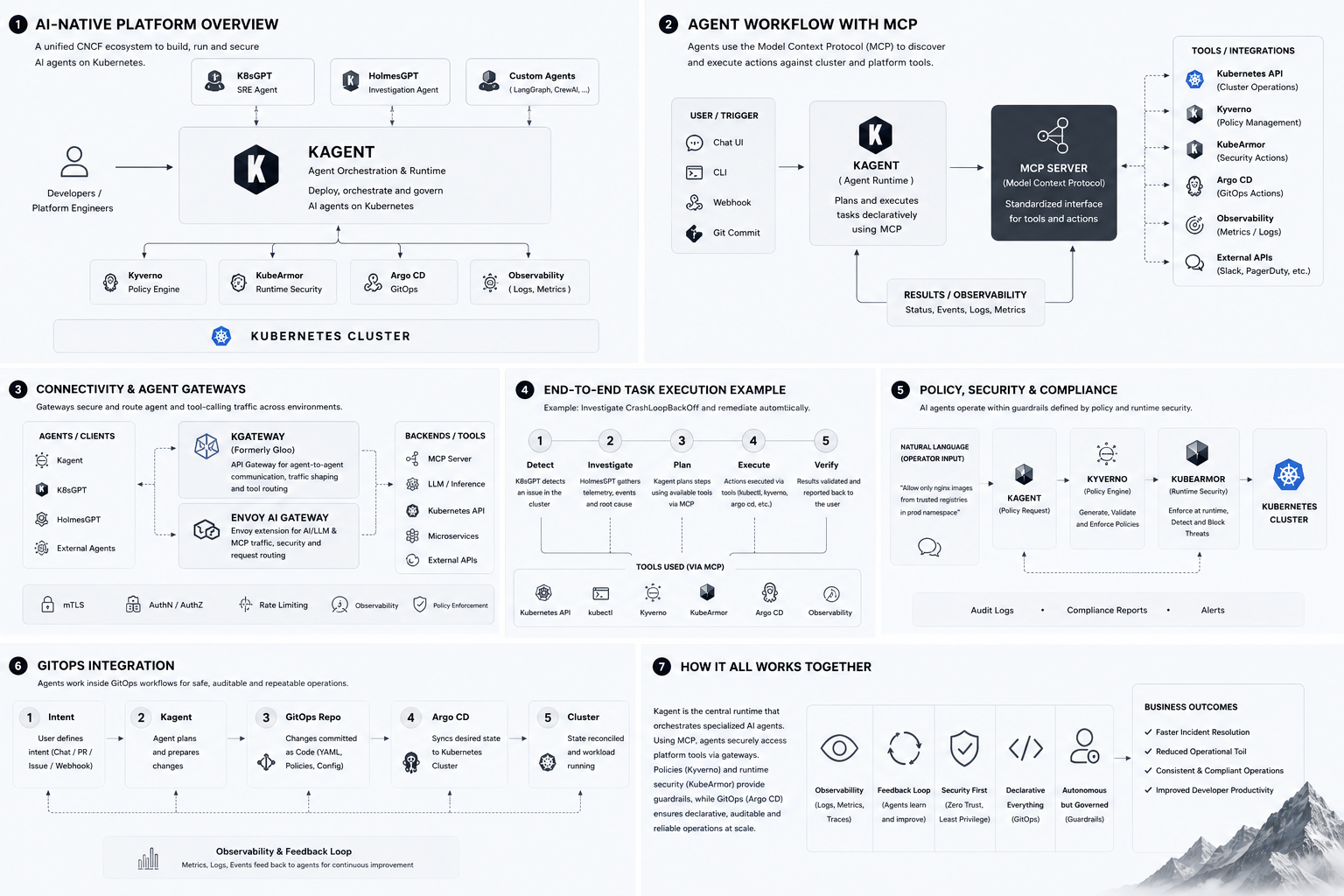
One runtime orchestrates the agents; one protocol — MCP — connects them to every tool; policy and runtime security hold the guardrails. Everything declarative, everything on the record, everything inside the cluster.

— e.g. a CrashLoopBackOff, investigated and remediated
1 / 5

Detect

K8sGPT spots the failing pod in the cluster scan.

2 / 5

Investigate

HolmesGPT gathers telemetry, events and the root cause.

3 / 5

Plan

kagent drafts the remediation steps from available tools.

4 / 5

Execute

Actions run through MCP — kubectl, Kyverno, Argo CD.

5 / 5

Verify

Results validated and reported back to the human.

— Field Notes

From the journal.

All essays →
— Observability

Logs you grep at 3am
is not observability.

Observability is not a tool. It is the ability to ask any question of your system from the outside and get an answer without changing the code. Most teams have monitoring. Few have observability.

We build the kind where you open a dashboard and know what is wrong in 10 seconds. Where alerts fire before your users notice. Where the on-call engineer follows a signal, not a hunch.

Metrics

Prometheus scraping every service. Grafana dashboards your CTO can read at a glance. SLOs with error budgets that tell you when to slow down, not just when something broke.

SLOsError budgetsGrafana dashboardsAlerting rules

Traces

OpenTelemetry distributed tracing. Follow a request across every service. See where it slows, where it fails, where it waits. The difference between knowing something is slow and knowing why.

Distributed tracesSpan analysisLatency budgetsService maps

Logs

Structured logs in Loki, not grep in a terminal. Correlated with metrics and traces. When an alert fires, the logs that matter are one click away, not one grep away.

LokiStructured loggingLog-metric correlationContext-rich
— The Alerting Pipeline
STEP 1
Metric breaches SLO
Prometheus rule fires
STEP 2
AlertManager routes
Based on severity + service
STEP 3
PagerDuty / Slack
Right person, right channel
STEP 4
Runbook attached
Not a link. The actual steps.
STEP 5
Human acts
Informed, not guessing
85%
Alert noise reduction
< 60s
Mean time to detect
< 12 min
Mean time to resolve
3
Dashboards per service
— Questions

Asked at the trailhead.

What technologies do you specialise in?

The CNCF stack: Kubernetes, ArgoCD, Prometheus, OpenTelemetry, Envoy, Cilium, Terraform. Plus the agentic layer: kagent, K8sGPT, HolmesGPT, kgateway, Kyverno, KubeArmor. We are vendor-neutral. Your platform should outlive any single cloud provider.

Can you help us migrate to Kubernetes?

Yes. We handle migrations from VMs, Docker Compose, ECS, and Cloud Run to Kubernetes. We also tell you honestly if you are not ready for Kubernetes yet. Sometimes a well-run VPS is the right answer for your stage.

Do you work with teams outside Estonia?

Yes. We serve clients across the EU, Middle East, and US. All work is remote-first. We have operated production from Leh, Ladakh at 3,524m for years. Distance is a design constraint we have already solved for.

Do you offer ongoing support or only project-based work?

Both. Expedition is a one-time audit. Ascent is a monthly retainer. Residency is a quarterly partnership. Most clients start with Expedition and move to Ascent once they see the value.

How do you ensure security and compliance?

Security is built in, not bolted on. We implement Pod Security Standards, network policies, secrets management, supply-chain signing, and policy-as-code from day one. We are GDPR-compliant and ISO 27001-ready. But we start with a threat model, not a certificate.

What makes you different from other DevOps consultancies?

We practice DevOps with a semi-agentic approach, not fully autonomous. AI agents sit inside our pipelines, our incident response, and our code review, governed by MCP. But humans are always in the loop. Agents propose actions. Humans approve them. Every action is logged, reversible, and audited. We are in transition from traditional DevOps toward agentic DevOps, and we think that is the right place to be.

— Services

Three ways we modernise your infrastructure.

Not a pitch deck. Working infrastructure, delivered in weeks, owned by you.

— Tools We Deploy

The stack we actually run in production.

Not a list of buzzwords. These are the tools we install, configure, and hand over to your team.

Kubernetes
Prometheus
ArgoCD
Helm
OpenTelemetry
Envoy
Cilium
Backstage
Terraform
GitHub Actions
AWS
GCP
Azure
Cloudflare
Docker
Ansible
Claude
vLLM
— Field Notes

Latest from the journal.

— Begin

Bring us your loudest system.

We'll return it to silence.

Or email hello@digitalaultis.com