OpenClaw and the age of personal agents
The fastest-adopted agent framework in open source runs on hardware you own, speaks through your messaging apps, and holds your credentials. What its rise teaches operators about running agents safely.
Every infrastructure shift announces itself twice: first as a toy, then as a workload. OpenClaw — the open-source personal agent that began life as Clawdbot, briefly became Moltbot, and settled on its current name while collecting GitHub stars faster than almost any project in recent memory — has now announced itself both ways.
The premise is simple and slightly radical. Instead of renting an assistant inside someone else’s cloud, you run one on a machine you control — a Mac mini in a drawer, a small VPS — and you talk to it where you already talk: WhatsApp, Telegram, Discord. It remembers. It schedules. It reads your mail, browses, runs commands, and extends itself through a growing ecosystem of community skills.
It is also, from an operator’s point of view, the most interesting thing to happen to personal computing in years: ordinary people are now running a privileged, internet-connected daemon with shell access and a credit card on file. That is an ops story, whether anyone calls it one or not.
The shape of the thing
Architecturally, OpenClaw is a gateway. One long-running process owns the messaging connections, the session state and the skills; the intelligence itself is rented per-call from model APIs. The hands — shell, filesystem, browser, cron — live on the host.
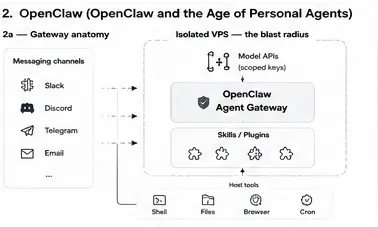
Fig. 1 — The gateway pattern. Channels in, models out, hands on the host. The dashed boundary is the only security line that matters.
This pattern — a thin, stateful gateway between chat surfaces and rented intelligence — is worth studying even if you never run OpenClaw, because it is rapidly becoming the default shape of every agent deployment, personal or corporate.
An agent is a privileged workload
The excitement around personal agents has outrun the operational vocabulary for them. So here is ours: an agent is a privileged workload with a language interface. Treat it exactly as seriously as that sentence implies.
The same questions you would ask of any daemon holding credentials apply, with one addition — this daemon reads untrusted text from the internet and can be argued with. Prompt injection means every email, web page and calendar invite the agent reads is potential instruction. You cannot fully prevent that today. You can only decide, in advance, how much an attacker wins.
- Give it its own machine. A small, isolated VPS is the natural blast radius — never your laptop with your SSH agent loaded, never a production host.
- Scope every credential. App-specific passwords, read-only API tokens, a separate browser profile. The agent gets a wallet with pocket money, not your bank card.
- Constrain egress and watch it. Firewall rules and a log of outbound calls turn “what did it just do?” from a panic into a query.
- Snapshot before you extend it. Community skills are unaudited third-party code with shell access. Pin versions. Read them.
- Keep its memory and configuration in git. When the agent drifts, you want a diff, not a séance.
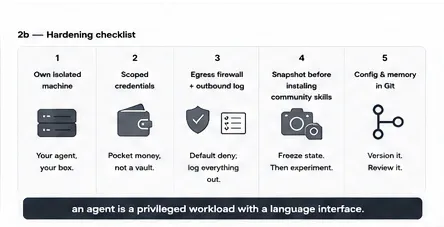
Fig. 2 — Five habits before the first conversation. None of them are exotic; all of them are old discipline.
Why this matters to companies
You may not plan to run a personal agent. Your staff already do. Like the first wave of shadow SaaS, personal agents will arrive bottom-up — connected to work email, work Slack, work calendars — long before any policy mentions them.
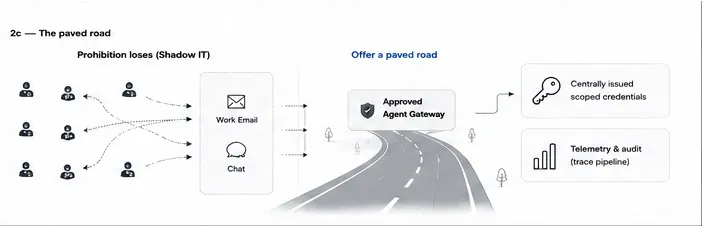
Fig. 3 — Shadow IT always arrives before policy does. Build the road before the goat paths harden.
The lesson of every previous wave is that prohibition loses to a paved road. The companies that come through this cleanly will be the ones that offer one: an approved gateway on isolated infrastructure, scoped credentials issued and revoked centrally, agent activity traced like any other production system. That is not exotic work. It is ordinary platform engineering applied to a new tenant.
The instinct is right
What we find most hopeful about OpenClaw’s rise is the instinct underneath it: when given something genuinely powerful, tens of thousands of people independently decided it should run on hardware they own, under their control, where they can read the logs. Sovereignty first; convenience second.
That is the correct instinct. It is the same one this practice is built on. The agents have come home — to machines we own. Now we owe them the discipline we give every other thing that runs there.